

Lee este artículo en español: Estudio de SDSU documenta el costo en salud de la contaminación del río Tijuana
Source: San Diego State University, “New SDSU research exposes health toll of ongoing Tijuana River pollution crisis,” SDSU News, November 13, 2026. Findings published in BMC Public Health.
TIJUANA, Baja California — The sewage crisis in the Tijuana River now has hard health data behind it. A San Diego State University study published in the journal BMC Public Health finds that most adults living with the pollution report respiratory, digestive and psychological symptoms, and many have changed how they live day to day to avoid the air.
The river carries untreated sewage, industrial waste and urban runoff from Tijuana through the Tijuana River Valley and into the Pacific Ocean. The problem worsened in the summer of 2024 after sewage infrastructure failures and a major wastewater overflow. SDSU launched the Healthy Water Healthy Air Study in September 2024 in response to community concerns.
What the study found
The baseline analysis covers 409 adults who completed the survey through October 31, 2025. Participants were invited to answer monthly follow-up surveys for a year, and SDSU reports that data from 489 participants through May 2026 confirm the same pattern.
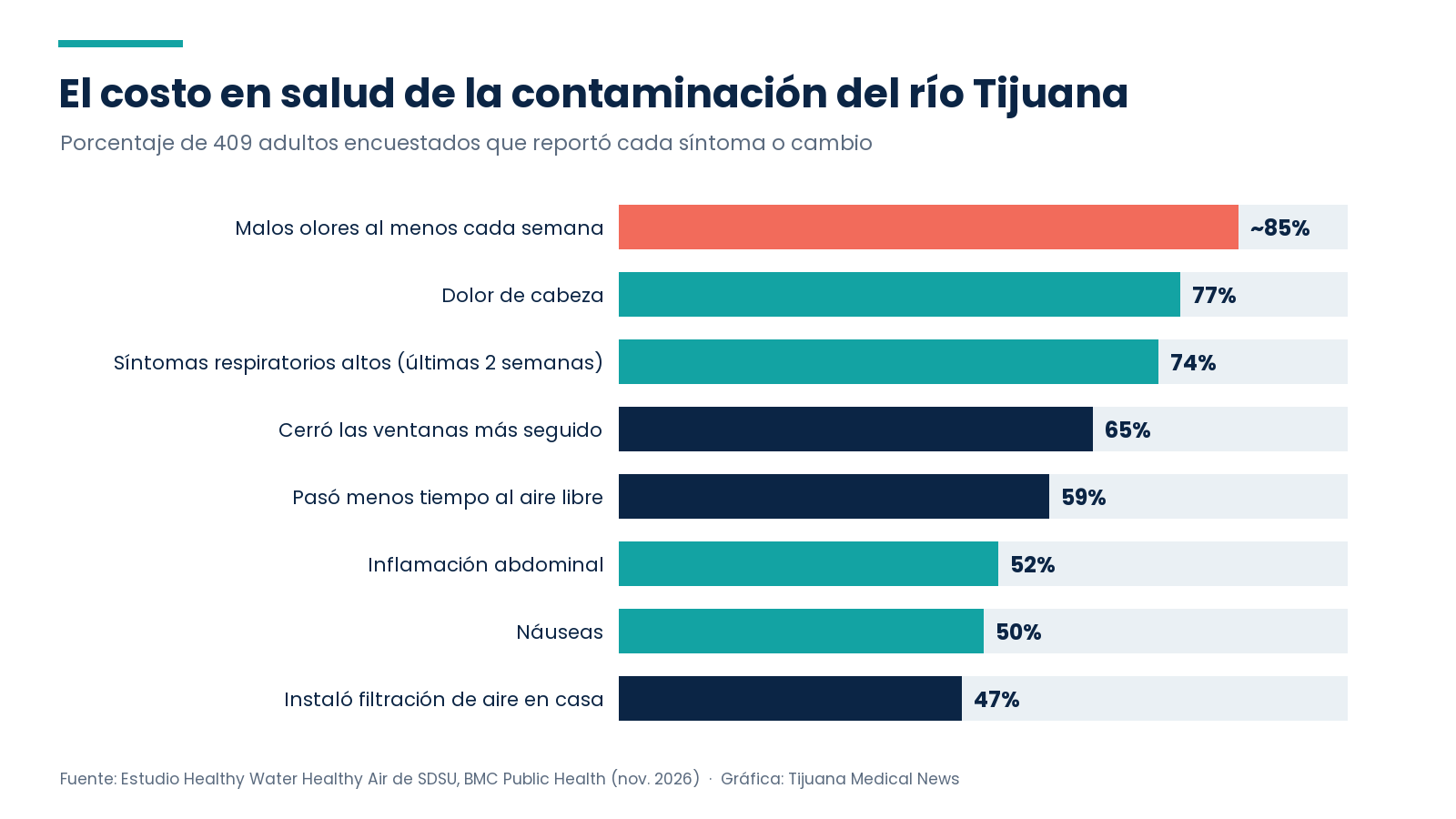
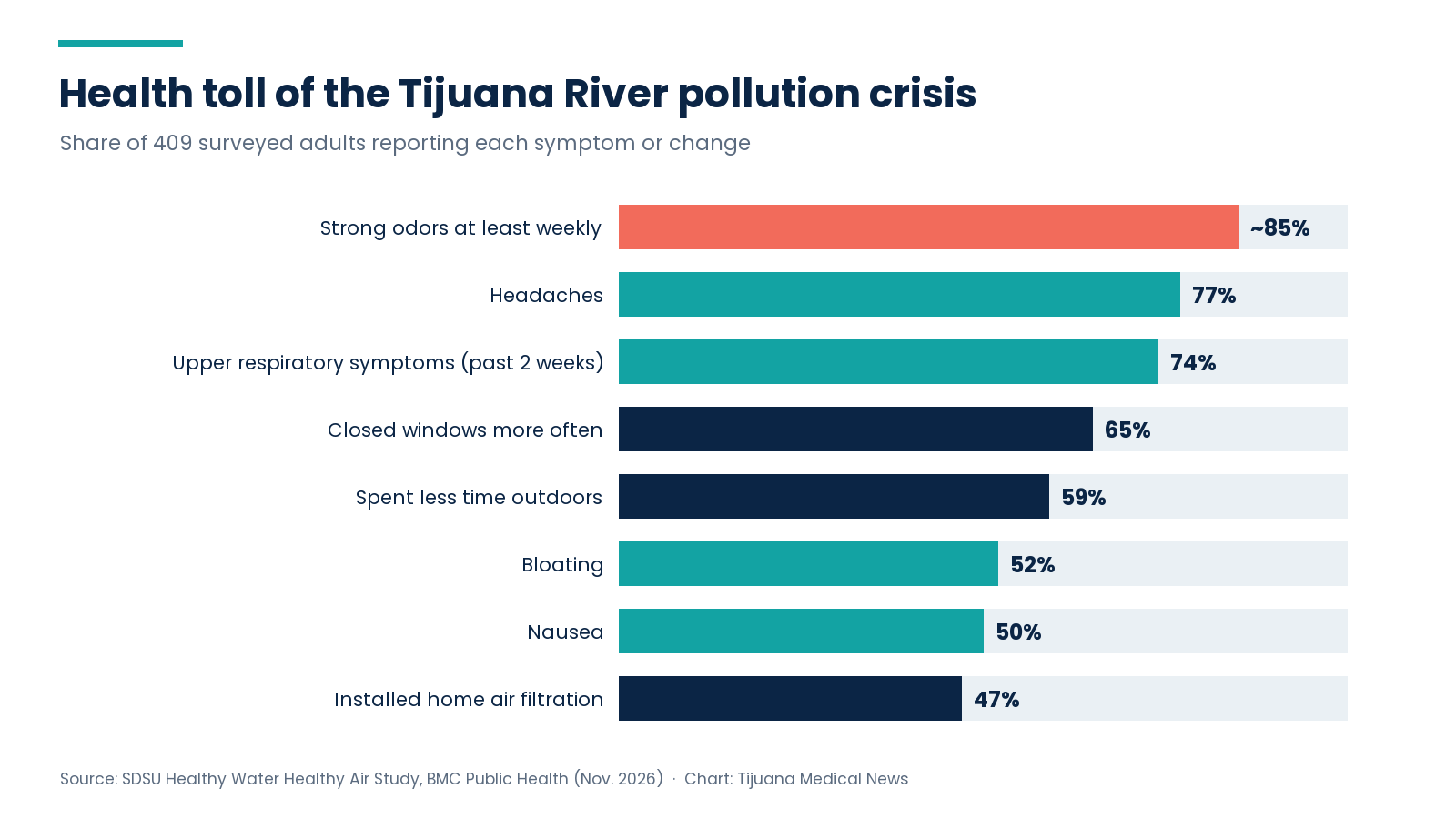
- Respiratory symptoms: 74% reported at least one upper respiratory symptom in the previous two weeks.
- Other symptoms: 77% reported headaches, 52% bloating and half reported nausea. Poor sleep, trouble concentrating and other signs of psychological distress were also common.
- Odors: nearly 85% said they smelled strong foul odors at least once a week, and most rated local air quality as unhealthy or worse.
- Changes at home: 65% kept windows closed more often, 59% spent less time outdoors and 47% installed home air filtration. Others moved exercise indoors, cut back on strenuous activity or limited visits to their homes.
Perception of the air tracked closely with symptoms. People who rated the air worse than “good” or “moderate” had a 35% to 80% higher prevalence of upper respiratory symptoms, depending on the rating. More frequent odors and poorer air ratings were also linked to more gastrointestinal symptoms and more psychological distress.
Who led the research
The study is led by Paula Stigler Granados, associate professor in the Environmental Health and Global Health Division of the SDSU School of Public Health, with researchers from SDSU, UC San Diego, the University of Washington and Kaiser Permanente. Community members from Imperial Beach and clinicians from South Bay Urgent Care are co-authors. Stigler Granados described the crisis as a local one: “It’s not in our backyard. It’s in our front yard.”
The study was approved by SDSU’s Institutional Review Board and supported by the Prebys Foundation, with data-system support from SDSU’s HealthLINK Center, funded in part by the National Institutes of Health.
Limits of the findings
The researchers are clear about what the data can and cannot show. The baseline analysis is cross-sectional, so it shows links between pollution exposure and symptoms but does not prove cause and effect. Participants were not chosen through representative sampling: they skewed toward women, White residents and higher-income households, while Hispanic and Latino residents and lower-income households were underrepresented.
That gap matters. The study notes that air filters cost money, outdoor workers cannot simply stay inside and housing conditions affect how well residents can keep polluted air out. The people least able to protect themselves may be the ones least represented in the data.
Why it matters for Tijuana
The Tijuana River is a binational problem: the pollution starts on the Mexican side of the border and affects communities on both sides. Research like this gives health authorities, policymakers and residents in Tijuana and San Diego a shared, measurable picture of the damage, beyond complaints about odors.
For Tijuana’s health sector, which serves thousands of patients from the United States each year, a cleaner border region is part of the city’s reputation as a place to receive care. Clinics, hospitals and public health officials have a direct stake in seeing the sewage problem fixed.
What residents and visitors can do
- Follow beach closure and water-contact advisories, and stay out of water near the river mouth when warnings are posted.
- On days with strong odors, keep windows closed and use a HEPA air purifier if available.
- See a doctor for persistent headaches, breathing problems, nausea or digestive symptoms, and mention possible exposure to sewage-polluted air or water.
Read the original report: SDSU News: New SDSU research exposes health toll of ongoing Tijuana River pollution crisis
This article summarizes research announced by San Diego State University and is for general information only. It is not medical advice. Talk with a licensed physician about any symptoms.